How to Run a Backyard Plant Sale: Inventory, Reservations, and Pricing
A backyard plant sale is one of the best things a serious gardener can do with surplus: extra tomato starts, divided perennials, a flat of rooted cuttings. It’s also more logistics than it looks. Which plants are actually ready? How many of each? Who said they wanted the last three Thai basil? Did you charge enough to cover the pots?
This guide covers the practical side: planning what to grow, tracking inventory, pricing, taking reservations, checkout on the day, and the rules to check first. We’ll use a real backyard nursery’s live page, Clearwater Seedling Co, as an example throughout.
1. Check the rules first
Before you plan a single flat, find out what your state requires. This is the step most people skip, and it varies a lot:
- Nursery licenses. California requires a license to sell any rooted plant. Colorado exempts sellers under $1,000 a year. Washington has a $20 plant-sale permit. Florida growers register with the state’s agriculture department; Clearwater Seedling Co lists its registration number on its page.
- Inspections and quarantines. Some crops (citrus is the classic example) are tightly regulated.
- Invasive species lists. Some popular plants are banned from sale in some states.
- Plant patents. Propagating and selling a patented cultivar without a license can infringe. See is it legal to sell cuttings of patented plants?
- Sales tax. Whether you owe it depends on your state and how much you sell. Keep good records either way.
Your state department of agriculture and your local extension office are the places to ask. It’s a short phone call that can save you a fine.
2. Plan what you’ll sell, and when
Work backward from your sale date. Seed-grown vegetables need 6–8 weeks to reach a sellable 4-inch pot; cuttings need time to root and then harden off; divisions need a few weeks to recover in their pots.
A few planning tips:
- Grow what’s hard to find. Common plants compete with every big-box store. Rare peppers, heirloom tomatoes, natives and unusual herbs give buyers a reason to come to you. Clearwater’s page leads with a “Rare Peppers” category.
- Time crops to your local season. Sell tomato starts when people in your area are planting tomatoes. Clearwater says its plants are timed for Florida’s planting seasons, which is why cabbage, broccoli and lettuce show up as “Coming soon” in early fall.
- Stagger sowings. A second wave of popular plants a few weeks later keeps you stocked for a second sale. Clearwater’s page has lots like “Everglades Cherry Tomato - Wave 5” alongside the earlier batch.
- Over-start. Not everything germinates or roots. Start 20–30% more than you plan to sell, and track how many actually make it.
3. Track inventory by variety, pot size and readiness
The single biggest headache at a plant sale is inventory drift: you think you have 14 rosemary, but four sold at the last market, two died on the bench, and three are promised to a neighbor.
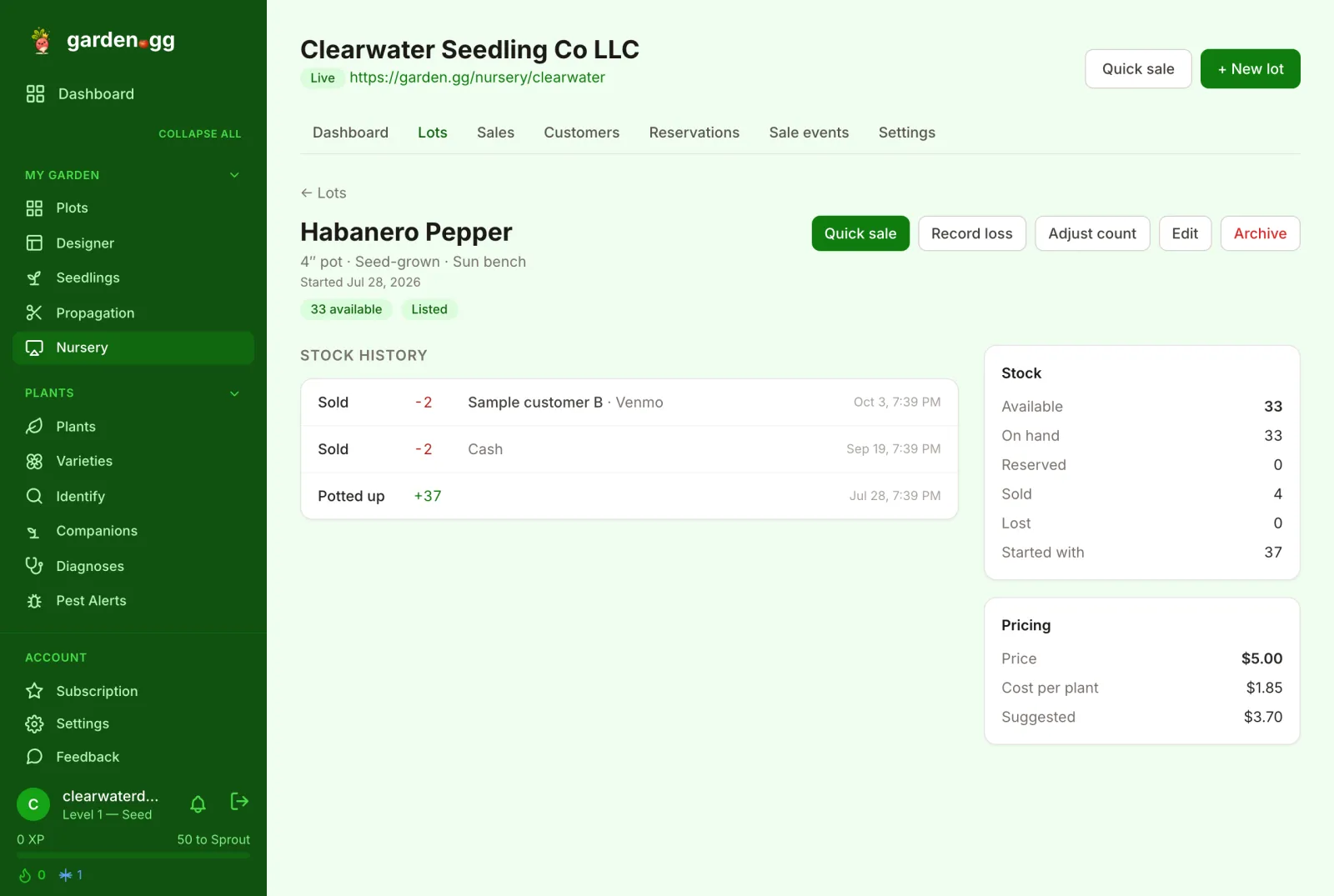
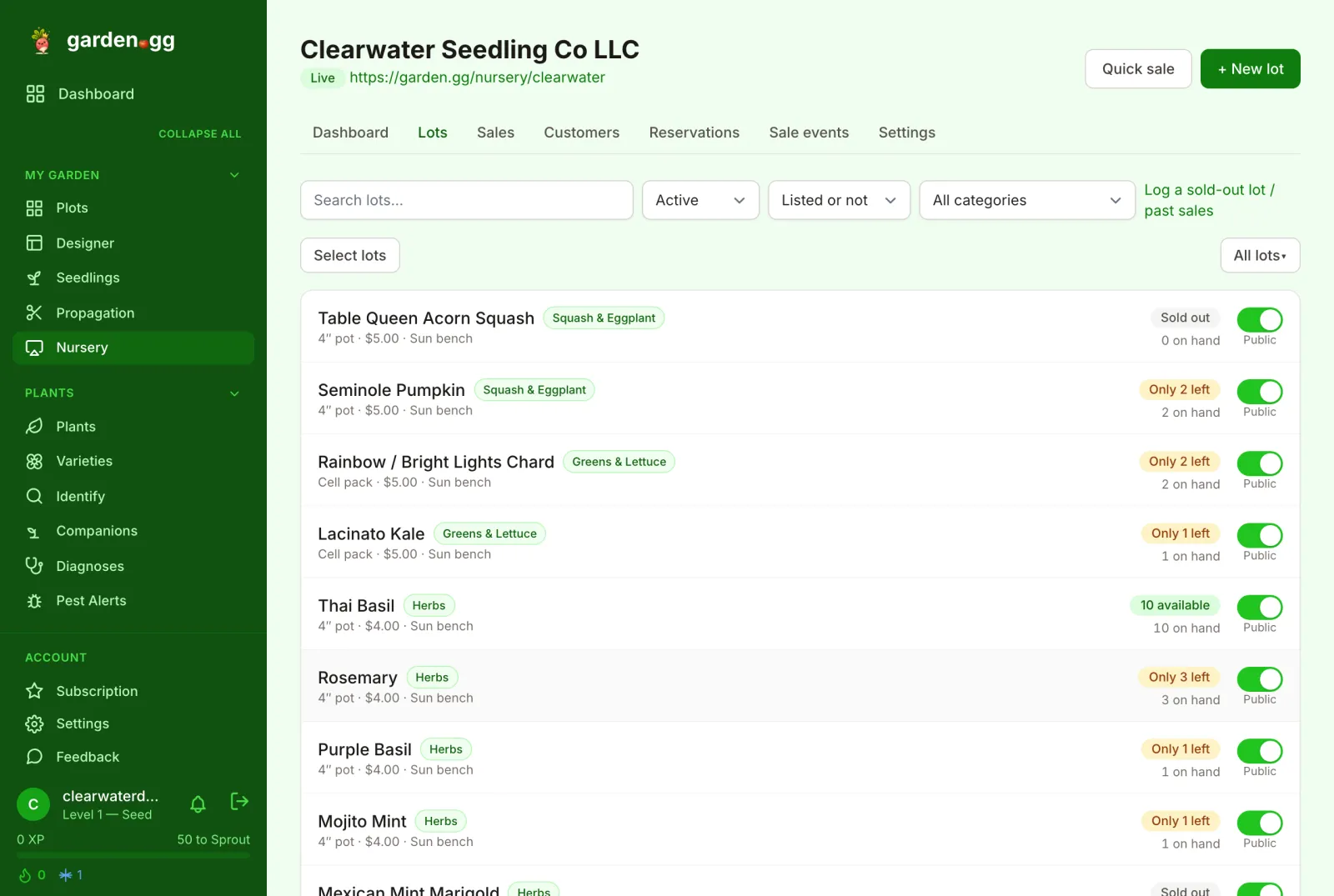
The fix is to track plants in lots: a group of identical plants with one variety, one container size and one price. “Rosemary, 4-inch, $4” is a lot. “Rosemary, cell pack, $3” is a different lot.
For each lot, keep:
- the quantity on hand
- how many are reserved for someone
- whether it’s ready or still growing (and roughly when it’ll be ready)
- every change: sales, losses, recounts
A spreadsheet works for a few varieties. Past that, it gets painful, because every sale has to be typed in twice. The garden.gg nursery tools were built for this: each lot keeps an append-only stock history (“Sold”, “Lost”, “Reserved”, “Picked up”), so the counts are always right, and lots can be grouped into your own categories. See lots and pricing for how it works.
4. Price honestly
Most backyard sellers underprice because they only count the pot and soil. A real cost per plant includes:
- materials (pot, mix, label)
- your time, even at a modest hourly rate
- losses: the cuttings that never rooted and the plants that died on the bench
Divide everything you put in by the plants you can actually sell, then apply a markup. A 2× markup is a sensible starting point. Our guide on how to price plants you propagate has a worked example (12 cuttings, 9 rooted, $3.13 real cost per plant, about $6.27 at 2×) and a calculator you can use.
Then look at local prices. Rare plants can carry more; common herbs are capped by what the hardware store charges. For reference, Clearwater sells rare peppers at $7 and most tomatoes, peppers and herbs at $4–5 in 4-inch pots.
5. Publish an availability list
Buyers want to know what you have before they drive over. The old way is a photo of a whiteboard on Facebook, already out of date by the time anyone sees it.
A better way is a live availability list that updates as you sell:
- group plants into categories buyers understand (Tomatoes, Peppers, Herbs, Natives)
- show price and container size
- show availability honestly: “In stock”, “Only 3 left”, “Ready ~Oct 18”, “Sold out”
- include pickup instructions and your general location, never your exact address
With garden.gg on the Harvest plan, that’s your public page at garden.gg/nursery/your-name. Clearwater’s page is a real example: 9 categories, around 57 listed lots, and pickup instructions right at the top. It also has a printable list for people who prefer paper and a QR poster to put on the sale table, so buyers can check stock and reserve from their phones. See storefront and reservations.
6. Take reservations without the DM chaos
Reservations are great for rare plants and regulars, and terrible when they live in five different message threads. Some rules that keep them sane:
- One inbox. Every request should land in the same place, with the plants, quantities, the buyer’s name and how to reach them.
- Pickup windows. Offer a few set times (“Saturday 9am–12pm”, “Sunday 9am–12pm”, “Weekday evenings by message”) instead of open-ended “whenever works”.
- Confirm before you hold. Accept a request before setting plants aside, and tell the buyer how long you’ll hold them.
- Expire no-shows. If someone doesn’t pick up by the end of the hold, release the plants back to stock.
- Pay at pickup, unless you have a way to take deposits.
garden.gg’s reservations work this way: buyers request plants from your page and pick one of your pickup windows; anonymous buyers confirm their email first; you Accept, counter with smaller quantities, or Decline; accepted plants are held for the number of days you choose; requests you don’t answer expire after 72 hours; and marking Picked up records the sale. A Block buyer button quietly declines future requests from a problem buyer.
7. Market-day checkout
On sale day you need checkout to be fast, even with bad cell signal.
- Bring change and a card reader, or post your payment handles (Venmo and so on) on a sign.
- Record every sale as it happens, with what was paid and how. Reconstructing a sale day from memory never works.
- Group a buyer’s plants into one sale so totals and receipts make sense.
- Plan for no signal. Use a tool that saves sales offline and syncs later, or keep a paper tally as backup.
- Tag every plant. A tag with the variety (and ideally care info) saves you answering the same questions all day and helps buyers come back for more.
The garden.gg Quick sale cart is designed for the market table: tap each plant the buyer is taking, adjust a price for a discount, pick how they paid (Cash, Venmo, Card, Trade, Other) and record it as one sale. On the iOS and Android apps a sale made offline is saved on the phone and syncs when you’re back in range, and anything that can’t be applied (say the last plant already sold) waits under “Needs attention” instead of disappearing. See quick sale. For tags, Print tags on any lot makes Avery 5160 sheets or thermal labels with a QR code that opens a free care page for the plant; see plant tags.
8. After the sale: look at the numbers
Once the tables are packed up, take ten minutes with the numbers:
- Revenue and plants sold, by day and by plant.
- Sell-through: what share of what you brought actually sold. Very high sell-through on a plant means you could grow more, or charge more.
- Losses: which plants died or got composted, and why.
- Who bought: regulars are worth remembering for next season.
Export your sales to a spreadsheet for taxes. In garden.gg, the Sales page has filters by date, plant, event, payment method and buyer, and Export CSV downloads exactly what you filtered. If you sold plants before you started tracking, log past sales so next year’s comparisons are real.
Your plant sale checklist
- Check state licensing, plant patents and invasive lists
- Plan crops backward from the sale date; over-start by 20–30%
- Track stock in lots: variety, pot size, price, ready or growing
- Price from real cost (materials + time + losses) × markup
- Publish a live availability list with pickup instructions
- Take reservations in one place with pickup windows and expiry
- Record every sale at checkout, even offline
- Review sell-through and losses afterward
Try it with your own plants
If you’d rather not wrangle spreadsheets and DMs, the garden.gg nursery tools handle inventory, pricing, quick sales, a live availability page and reservations in one place, on the web and the iOS and Android apps. Stock tracking starts on Bloom ($5/month); the public page and reservations are on Harvest ($12/month). See pricing, or browse Clearwater Seedling Co’s live page to see what buyers see.
FAQ
How do I keep track of plant inventory for a plant sale?
Track plants in lots: one variety, one pot size, one price. Record every sale, loss and recount against the lot as it happens, so your counts stay accurate. A spreadsheet works for a handful of varieties; a tool built for it, like garden.gg’s nursery lots, keeps counts in sync with sales and reservations automatically.
Should I take reservations before a plant sale?
Reservations help with rare or limited plants and let regulars skip the line, but only if they’re managed in one place. Hold reserved plants aside, give buyers a pickup window, and release plants from no-shows promptly. Ask for payment at pickup unless you have a way to take deposits.
Do I need a license to sell plants from my backyard?
It depends on your state. California requires a nursery license to sell any rooted plant, Colorado exempts sellers under $1,000 a year, and Washington has a $20 plant-sale permit. Check with your state department of agriculture before your first sale.
How should I price plants for a backyard sale?
Start from your real cost per plant: materials, your time and the plants that died along the way, divided by the plants you can sell. Multiply by about 2× as a starting markup, then compare with local prices and adjust by plant.