How to Price Plants You Propagate (with a Cost-per-Plant Calculator)
Most backyard sellers price by feel: “$5 feels right for a 4-inch pepper.” Sometimes that’s fine. But if you propagate a lot, gut pricing hides two costs that quietly eat your margin: the cuttings that never rooted, and your own time.
This guide walks through a simple, honest way to price plants you propagate, with a worked example and a calculator you can use right on this page. It’s the same math the garden.gg nursery tools use for their suggested price.
Why “materials only” pricing loses money
Say a 4-inch pot, a scoop of potting mix and a plant label cost you 85¢. It’s tempting to treat 85¢ as your cost and call anything above it profit.
But you didn’t pot up one cutting. You stuck 12, and 9 rooted. The three that died still used a pot, soil, rooting hormone and a few minutes of your time. Those costs don’t disappear. They land on the 9 survivors.
Then there’s labor. Taking cuttings, sticking them, misting, potting up, labeling, hardening off and hauling plants to a sale all take time. Six minutes per plant doesn’t sound like much until you multiply it by a hundred plants.
A useful price has to cover three things:
- Inputs per plant: pot, media, label, anything consumed per unit.
- Losses: inputs spent on plants that didn’t make it.
- Your time, at an hourly rate you choose.
The cost-per-plant formula
Here’s the formula, written out in plain steps:
- Per-plant input = materials per plant + (minutes per plant ÷ 60 × hourly rate)
- Total cost = per-plant input × number you started + any plant material you bought (stock plants, plugs)
- Cost per plant = total cost ÷ number that survived
- Suggested price = cost per plant × markup
The key move is in steps 2 and 3: you multiply by what you started and divide by what survived. That’s how losses get priced in.
Worked example: 12 cuttings, 9 rooted
Let’s run real numbers:
| Input | Value |
|---|---|
| Cuttings started | 12 |
| Cuttings rooted (sellable) | 9 |
| Pot, soil and label per plant | $0.85 |
| Labor per plant | 6 minutes |
| Hourly rate | $15/hour |
| Plant material bought | $0 (cuttings from your own stock plant) |
Step 1, per-plant input: $0.85 + (6 ÷ 60 × $15) = $0.85 + $1.50 = $2.35
Step 2, total cost: $2.35 × 12 cuttings = $28.20
Step 3, cost per plant: $28.20 ÷ 9 survivors = $3.13
Step 4, suggested price at 2×: $3.13 × 2 ≈ $6.27
If you’d priced on materials alone (85¢) you might have thought $4 was a healthy price. The real cost is $3.13, so $4 leaves you 87¢ a plant, and nothing at all if a few go unsold. At around $6 you’re covering losses and time with room to discount.
Cost-per-plant calculator
Change any number and the results update. Nothing is saved or sent anywhere.
Total batch cost
$28.20
Cost per plant
$3.13
Suggested price
$6.27
Each sellable plant carries the cost of 1.33 starts.
Choosing a markup
The calculator defaults to 2× your true cost. Why double?
- Unsold plants. Not everything sells. Some plants get leggy, some get composted at the end of the season. Margin on the plants that sell pays for the ones that don’t.
- End-of-sale discounts. At 2× you can knock a dollar off the last few plants and still make money.
- Overhead you didn’t count. Water, shade cloth, trays, gas to the market, the folding table.
Then sanity-check against your market:
- Common, easy plants (basil, mint, tomatoes everyone grows) face a price ceiling set by big-box stores and other local sellers. If 2× puts you far above that, look at cutting costs (cell packs instead of 4-inch pots) rather than selling at a loss.
- Rare or slow plants (unusual peppers, natives that are hard to find, anything that took a year to size up) can carry a higher markup. Buyers searching for them aren’t comparing against a garden center.
- Bigger containers cost more to produce and take more bench space for longer. Price the time, not just the soil.
Track losses as they happen
The worked example only counts losses during rooting. Plants also die after you pot them up: a pest outbreak, a hot afternoon without water, culls that never sized up. Every one of those raises the cost of what’s left.
The easiest way to stay honest is to record losses when they happen rather than reconstructing them at the end of the season. Then your cost per plant updates on its own, and at season’s end you can see which plants actually made money, cuttings versus seed-grown versus divisions.
How garden.gg does this for you
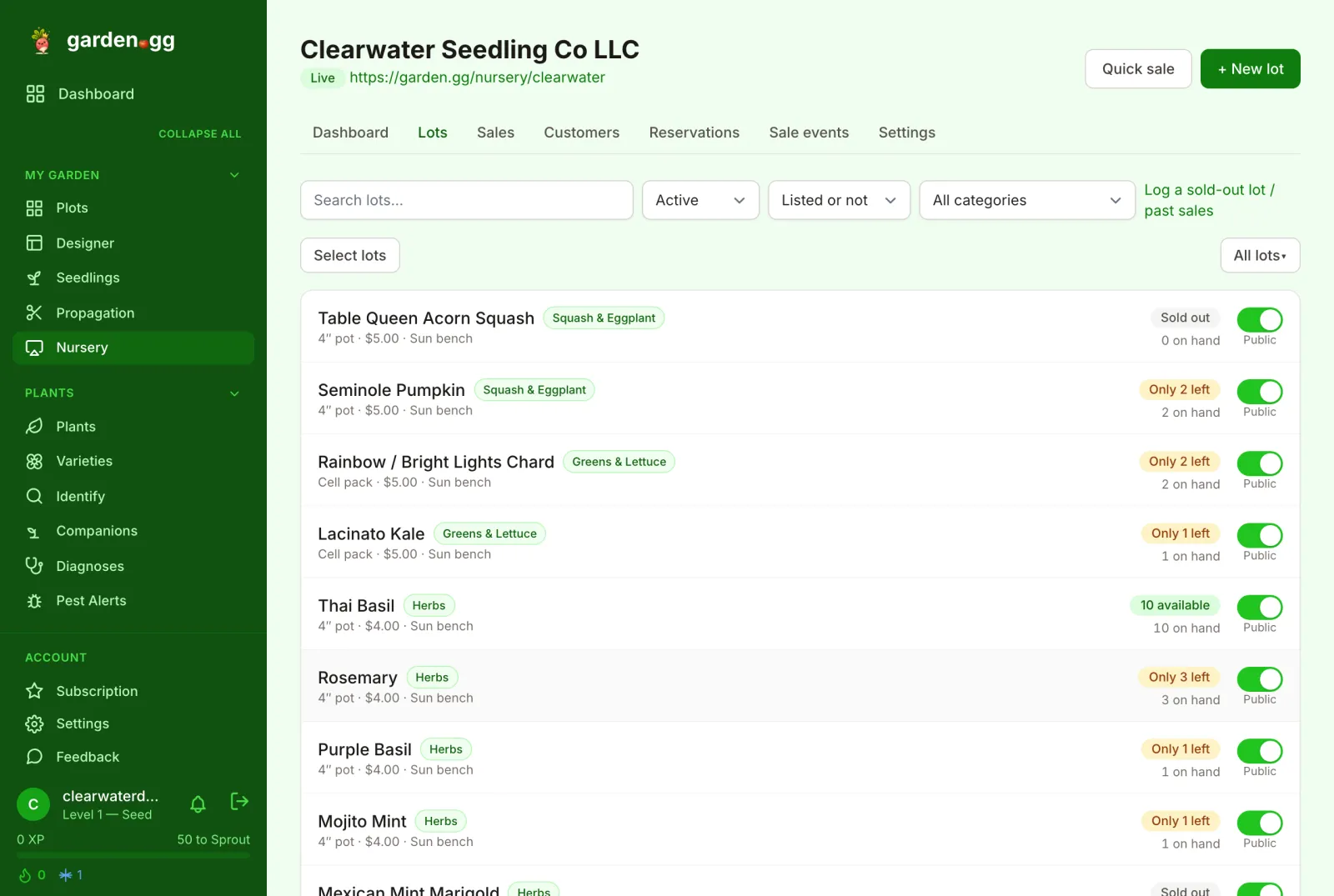
The garden.gg nursery tools run this exact formula on every stock lot:
- Enter Pot, soil & label per plant, Labor minutes per plant and an optional Markup on the lot. Your Labor rate / hour and Default markup are set once in Settings.
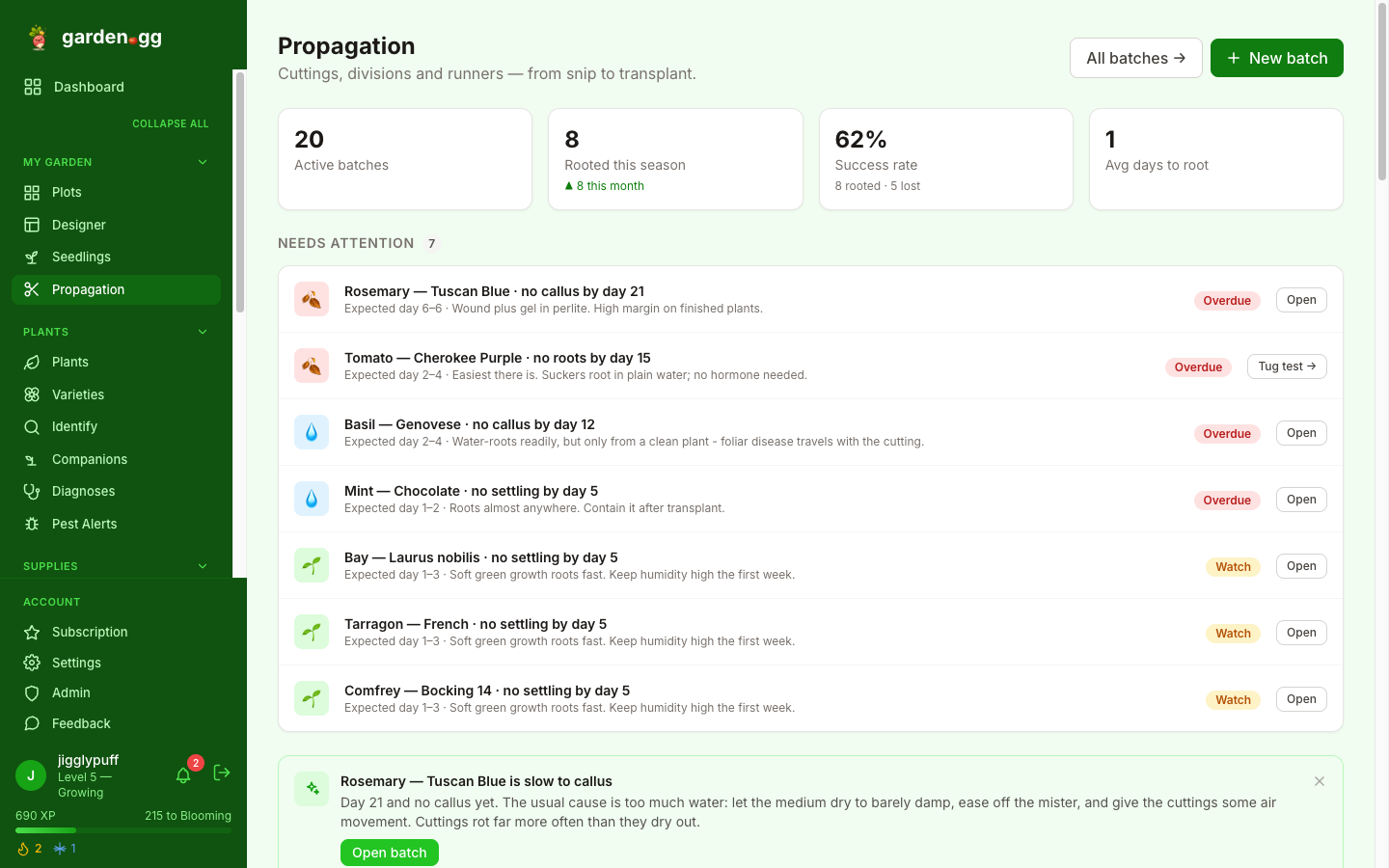
- If the lot came from a propagation batch (List for sale on the batch), the batch’s started-versus-survived ratio is carried in automatically. The lot even says “Includes propagation losses (1.33× cuttings per sellable plant).”
- Every Record loss updates the cost of the remaining plants.
- The lot shows Cost per plant and Suggested next to your price. It’s a hint, never applied for you.
The lots and pricing guide walks through each field. Cost tracking is included from the Bloom plan; see pricing.
Quick checklist
- Count every start, not just the survivors.
- Put a number on your time, even a modest one.
- Divide by survivors, then multiply by a markup (start at 2×).
- Compare with local prices and adjust by plant, not across the board.
- Record losses as they happen so your costs stay true.
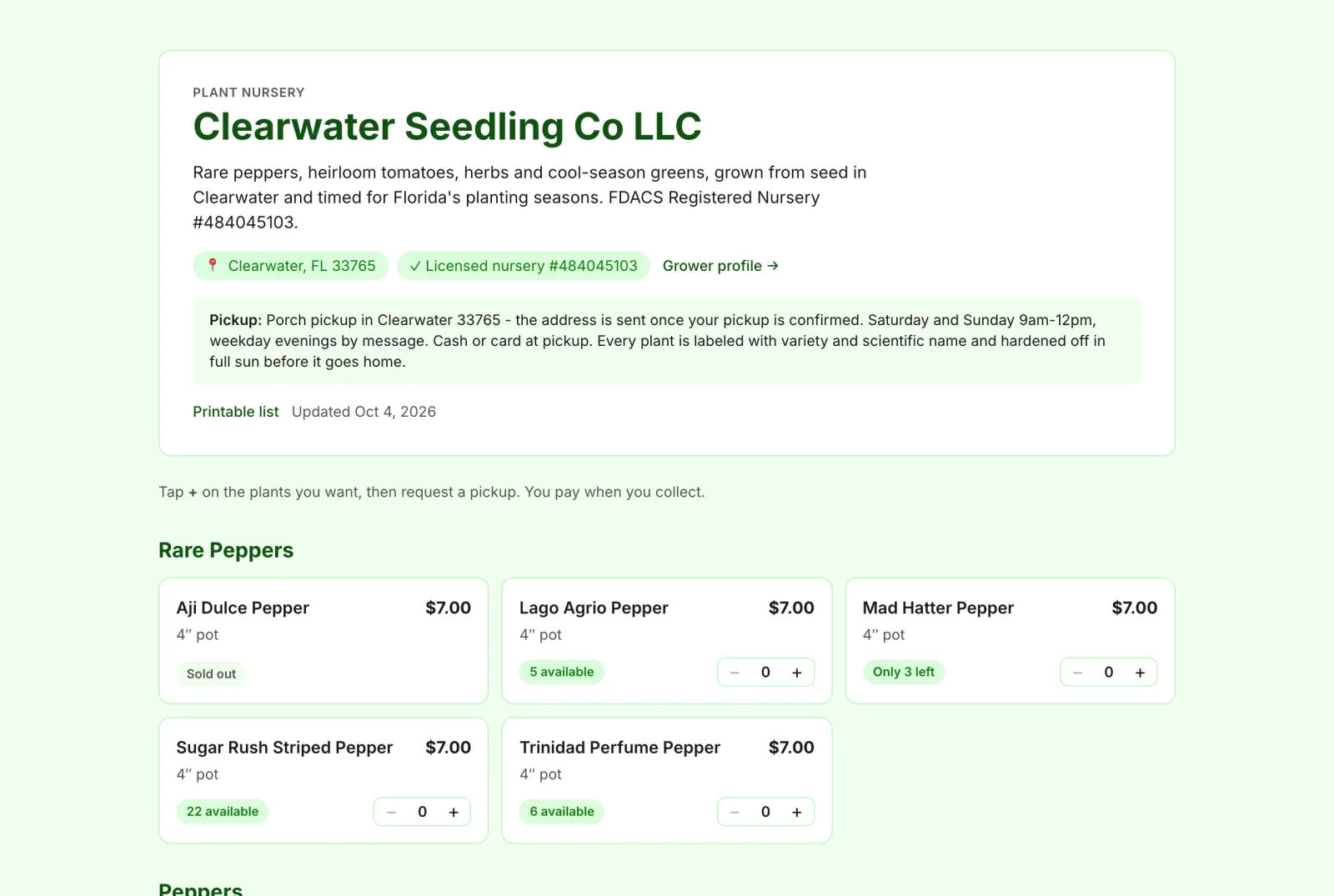
Want to see real prices in the wild? Clearwater Seedling Co’s live availability page lists rare peppers at $7 and heirloom tomatoes and herbs at $4–5 in 4-inch pots, all grown from seed. Next, read how to run a backyard plant sale for the selling side.
FAQ
How do I calculate the cost per plant for cuttings?
Add up what every cutting you started cost (pot, soil, label and your time), add any plant material you bought, then divide by the number that actually rooted. Losses raise the cost of the survivors, so a batch where 9 of 12 cuttings rooted costs a third more per plant than the materials alone suggest.
What markup should I use for plants I propagate?
A 2× markup on your true cost (losses and time included) is a sensible starting point for backyard sellers. It covers unsold plants and gives you margin to discount at the end of a sale. Then compare with local prices and adjust: rare varieties can carry more, common herbs less.
Should I count my own time when pricing plants?
Yes. Even a few minutes per plant adds up. At 6 minutes per plant and $15 an hour, labor is $1.50 a plant, which is often more than the pot and soil. If you leave it out, you can be busy every weekend and still not know whether the plants make money.
How do I account for cuttings that die?
Spread the cost of every cutting you started over the plants that survived. If you start 12 cuttings and 9 root, each sellable plant carries the cost of 1.33 cuttings. Plants lost later (culled, pests, unsold) raise the cost of the remaining plants the same way.