How to Track Plant Cuttings (So You Actually Know What Worked)
Take twelve cuttings in July. Stick them in perlite. Come back in October and count how many are alive.
That is how most people propagate, and it teaches you almost nothing. You know the final number. You do not know whether the four that died rotted in week one, sat there for six weeks and never callused, or rooted fine and then cooked on a windowsill. You do not know whether the perlite helped. Next July you will guess again.
Garden.gg now tracks propagation as a staged process instead of a single yes/no outcome. Cuttings, divisions, and runners all move through the same pipeline, and every batch carries the timing expectations for its species.
Why a single success number hides the useful information
Propagation has at least four distinct failure modes and they want opposite responses.
A cutting that rots in the first week was too wet. A cutting that sits for a month with no callus is usually too wet as well, but the fix is different: you want airflow and a drier medium, not a new batch. A cutting that calluses beautifully and never puts out roots often needed bottom heat or a hormone. A cutting that roots and then dies was weaned off humidity too fast.
If all you record is “6 of 12 made it,” you cannot tell those apart. So the tracker records the transitions, not just the ending:
stuck → settle → callus → rooting → rooted
   → transplanted
   → failed
Each transition is timestamped. When a batch fails you record why, and that reason stays attached to the method and medium you used.
Species windows, not generic advice
The part that took the longest to build is the least visible: a table of what normal looks like. Garden.gg ships 29 species profiles plus 4 category fallbacks, so a batch knows its own schedule from the moment you start it.
| Species | Category | Method | Hormone | Settle | Callus | Rooting |
|---|---|---|---|---|---|---|
| Basil | Herbaceous | Water | None | 1-2 | 3-6 | 5-10 |
| Coleus | Herbaceous | Water | None | 1-2 | 3-5 | 7-14 |
| Geranium | Herbaceous | Softwood stem | None | 1-3 | 4-8 | 7-21 |
| Hibiscus | Semi-hardwood | Softwood stem | Gel IBA | 1-4 | 7-14 | 28-56 |
| Fig | Hardwood | Hardwood stem | Powder IBA | 2-7 | 14-21 | 42-56 |
| Grape | Hardwood | Hardwood stem | Powder IBA | 2-7 | 14-28 | 42-70 |
| Elderberry | Hardwood | Hardwood stem | None | 2-7 | 14-21 | 42-70 |
| Camellia | Semi-hardwood | Semi-hardwood stem | Liquid IBA/NAA | 1-4 | 10-21 | 42-90 |
All numbers are days from the start of the batch.
Look at basil against camellia. Basil roots in water in a week and a half. Camellia can take three months and is rated hard for a reason. Judging both against a vague “check in a few weeks” is how people throw out camellia cuttings that were working.
If a species has no profile, the batch falls back to its category:
| Category | Difficulty | Settle | Callus | Rooting | Dome wean |
|---|---|---|---|---|---|
| Herbaceous | Easy | 1-3 | 4-8 | 7-14 | 5 days |
| Semi-hardwood | Moderate | 1-4 | 7-14 | 28-42 | 6 days |
| Hardwood | Moderate | 2-7 | 14-28 | 42-70 | 7 days |
| Unknown | Moderate | 1-3 | 4-10 | 7-28 | 6 days |
What a batch looks like day to day
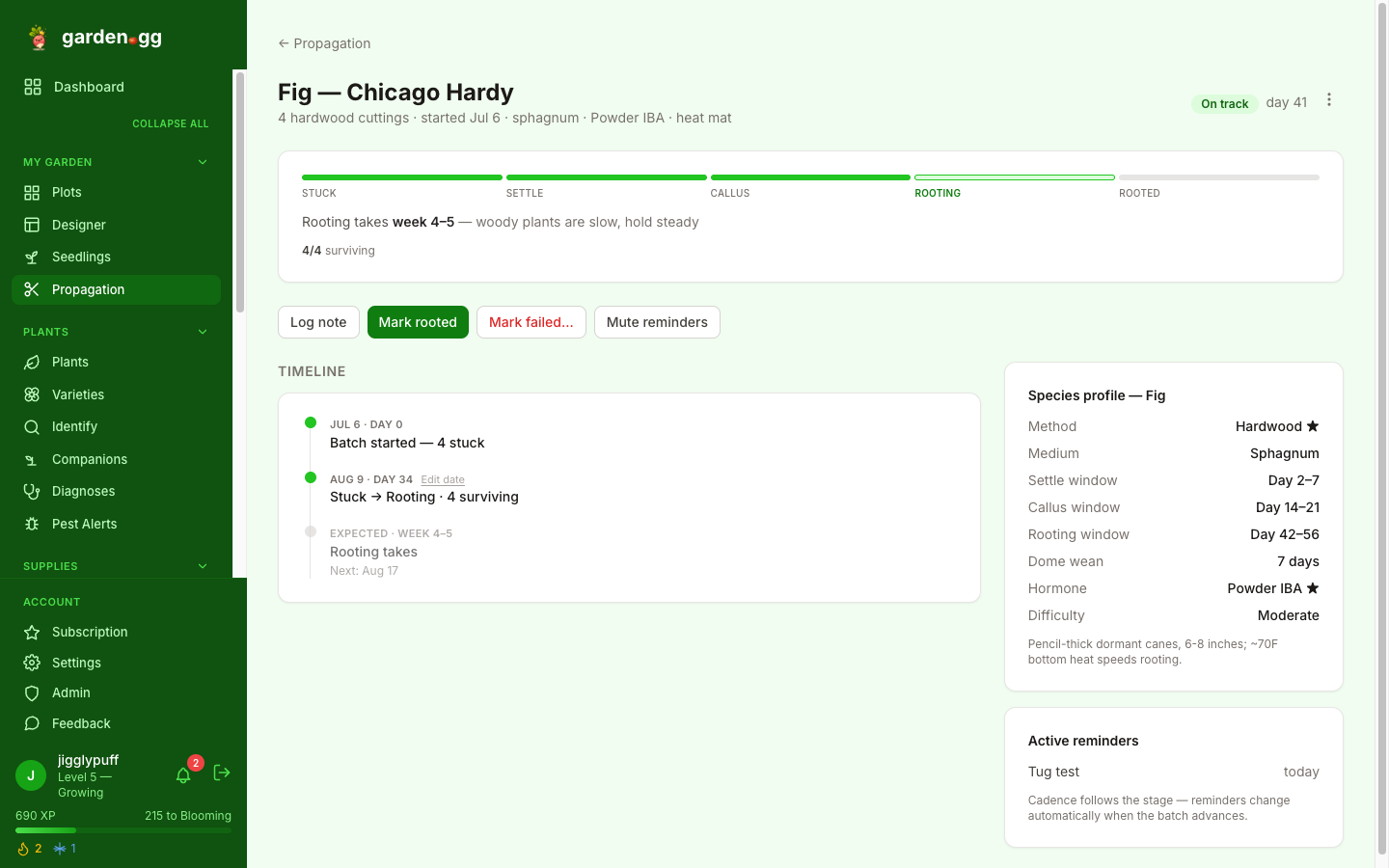
The batch above is four hardwood fig cuttings started on July 6 in sphagnum, with powder IBA and a heat mat. It is on day 41 and sitting in the rooting stage. The species profile says fig roots between day 42 and 56, so the progress bar reads “on track” rather than flagging it. Four of four are still alive.
That “on track” judgement is the whole point. Day 41 with no roots feels like failure. Against the actual fig window it is a day early.
Reminders follow the stage rather than a fixed calendar. A batch in settle gets misting prompts. A water-rooted batch gets water-change prompts. Once it enters rooting, the prompt becomes a tug test. When a batch advances, its reminder cadence changes automatically, so you are not still misting something that rooted three weeks ago.
The dashboard tells you what needs hands today
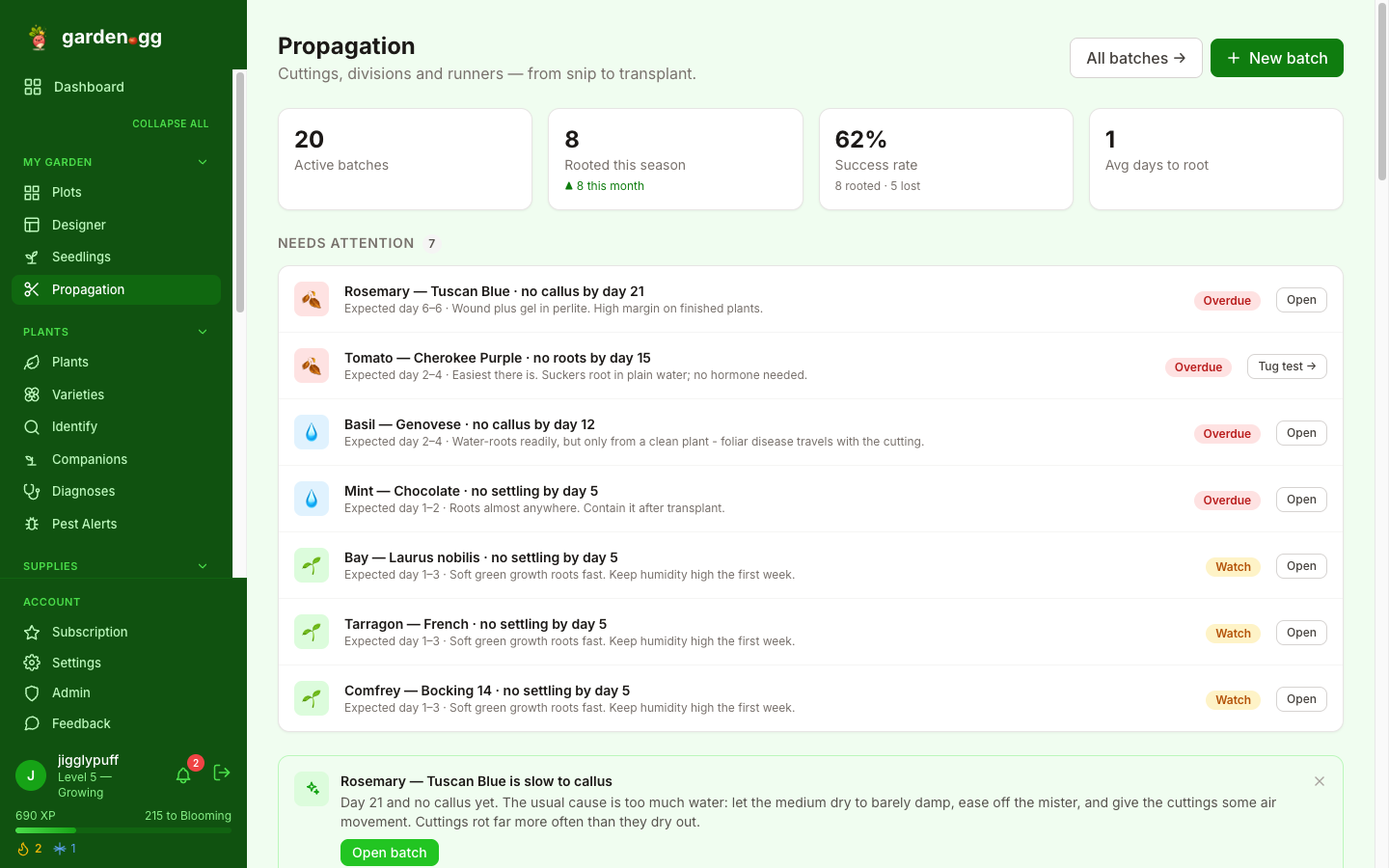
The needs-attention list is sorted by how far past its window a batch has drifted. In the screenshot above, four batches are marked overdue and three are on watch:
Rosemary, Tuscan Blue: no callus by day 21. Expected day 6-6. Wound plus gel in perlite. High margin on finished plants.
Tomato, Cherokee Purple: no roots by day 15. Expected day 2-4. Easiest there is. Suckers root in plain water; no hormone needed.
Each row carries the expected window and a note about that species, so the list is actionable without opening anything. Overdue batches also get a written diagnosis. The rosemary one reads: “Day 21 and no callus yet. The usual cause is too much water: let the medium dry to barely damp, ease off the mister, and give the cuttings some air movement. Cuttings rot far more often than they dry out.”
That last sentence is the single most useful thing in the feature, and it is the opposite of what most people’s instincts tell them.
Success rate that means something
Because every batch records method, medium, hormone, and environment, the success rate can be sliced. The account in the screenshot is running 62% across 8 rooted and 5 lost. That number on its own is mildly interesting. Broken down by medium, it starts paying rent.
Media you can record: water, perlite, sphagnum, coco coir, peat plug, rockwool, sand mix, and plain soil. Methods: softwood, semi-hardwood, and hardwood stem cuttings, water rooting, and division. Hormone options run from none through powder IBA, gel IBA, and liquid IBA/NAA.
After two seasons that becomes a real answer to “should I bother with rooting hormone on tomatoes.” (You should not. Tomato suckers root in plain water in under a week.)
Rooted cuttings keep their parentage
When a rooted batch gets transplanted into a plot, the resulting plant keeps a reference to the batch it came from. The clone knows its parent.
This matters more than it sounds. If you take cuttings from your best-producing tomato every year, three seasons later you have a row of plants and no memory of which original they descend from. With lineage recorded you can go back and check whether the good producer stayed good, or whether you have been propagating a plant that quietly declined.
Partial transplants work too. Root six, plant three, leave three in the tray, and only the three that moved get plant records.
Start with something that roots fast
If you want to see whether this fits how you garden, do not start with camellia in November. Take basil or coleus cuttings, put them in water, and let the tracker run for two weeks. Basil settles in a day or two and roots inside ten days, so you get a full cycle almost immediately and learn the interface on a plant that is hard to kill.
Then start the fig.
Propagation tracking is available on the web app, iOS, and Android. Batches sync across all three, so you can start a batch at the potting bench on your phone and review the timeline later on a laptop.