What Tools You Actually Need for a Vegetable Garden
Gardening tool guides are mostly written by people who want you to buy fourteen tools. You need about six.
Here is the honest version, followed by the thing we just built for the harder question: not what tools exist, but which specific ones the people growing well near you have settled on.
The six that earn their place
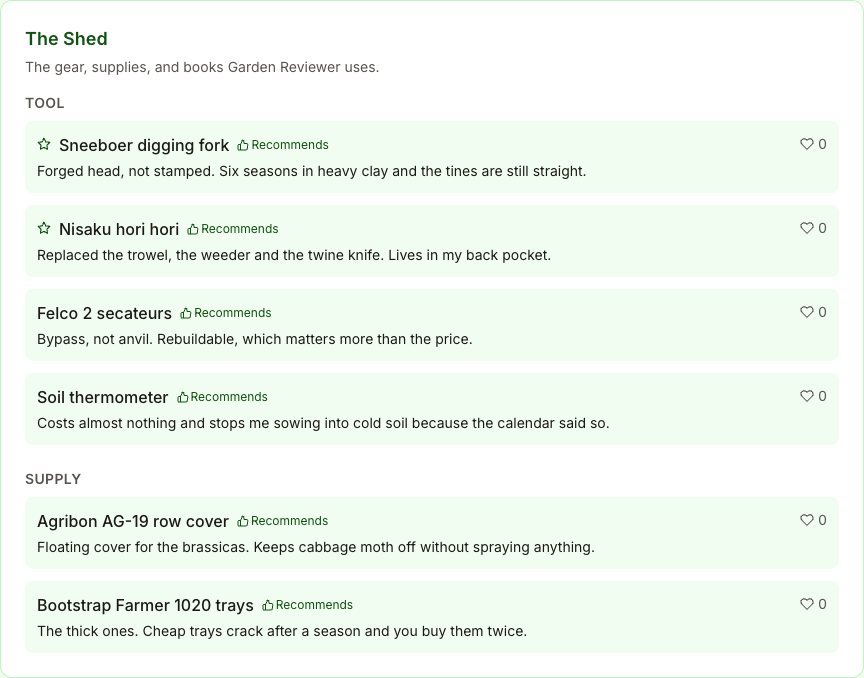
A digging fork. More useful than a spade in most established beds. It loosens compacted soil without inverting the profile and it lifts root crops without slicing them. If you buy one expensive tool, buy this one, and buy it with a forged head rather than a stamped one. Stamped tines bend on the first root you hit.
A hori hori. A heavy serrated knife that does the job of a trowel, a weeder, a bulb planter, and a twine cutter. It is the tool most experienced gardeners carry and most beginners have never heard of. Once you have one, the trowel stays in the shed.
Bypass secateurs. Bypass, not anvil. Anvil pruners crush stems, which is fine on dead wood and bad on anything living. Clean cuts matter for disease.
A watering can with a fine rose, for seedlings, or a hose wand with a shutoff for everything else. The thing that matters is being able to water at the base without blasting soil onto leaves, because soil splash is how a lot of fungal disease reaches foliage in the first place.
A garden fork’s smaller sibling, the hand fork, for container work and tight spacing.
A soil thermometer. Costs almost nothing and prevents the most common beginner mistake, which is sowing into cold soil because the calendar said so. Peas do not care what week it is. They care that the soil is above about 40°F.
That is the list. Everything else is optional.
What you can skip for now
Raised bed kits before you know where the sun falls. A tiller, which will do more harm to soil structure than the work is worth on a garden this size. Seed-starting heat mats until you have failed at seed starting without one. Fancy stakes, when a bundle of bamboo canes costs a fraction as much. Anything described as ergonomic that costs four times the plain version.
Gloves are the exception to the minimalism. Buy the ones that fit. Bad gloves stay in the shed and you garden bare-handed and then you get a thorn in your palm.
The harder question tools guides do not answer
Knowing you need secateurs is easy. Knowing which secateurs, and whether the expensive Japanese ones are worth four times the hardware-store pair, is where generic advice runs out.
The useful answer usually comes from a specific person. Someone who grows in your climate, at your scale, and has used the thing for three seasons. That person exists and until recently there was no good way to ask them.
Garden.gg profiles now include The Shed: a list of the gear a gardener actually uses, attached to a public profile alongside what they grow. It is not a review site and it is not a wishlist. It is what is in that person’s shed.
Why attaching gear to a profile changes the answer
A tool recommendation is only as good as the context around it, and a profile carries that context.
If you open a gardener’s profile and see they grow in zone 5, garden in four raised beds, and have been logging for two seasons, their tool list means something. If they are a zone 10 market grower with a half acre, their list is real but it is not for you. Same recommendation, completely different weight, and you can only tell the difference because the gear sits next to the garden.
You can browse gardeners through the directory at garden.gg/gardeners, filter toward people growing what you grow, and look at what they use. It is closer to walking through someone’s garden and asking about the fork in their hand than to reading a listicle.
Affiliate links are disclosed automatically
Some Shed entries link to products, and some of those links are affiliate links. Garden.gg adds the disclosure automatically on any public profile that has them. The user does not have to remember, and cannot quietly opt out.
This is worth being blunt about. Undisclosed affiliate links are most of what is wrong with tool recommendation content on the internet. The reason the top result for “best pruners” recommends whatever it recommends often has nothing to do with pruners. Making disclosure automatic and structural rather than a footnote someone might add is the only version of this that is trustworthy.
You should still weight a recommendation lower when money is attached. The disclosure exists so you can.
Build your own list, mostly for yourself
The unexpected use for The Shed is personal record keeping. Write down what you bought, when, and whether it worked.
Three seasons in you will not remember which brand of row cover you liked, what size drip emitters you standardised on, or the name of the tomato cage design that did not collapse. If it is on your profile, you can look it up, and so can the person who asks you about it.
Profiles are opt-in and default to private. Nothing goes public unless you make it public.
Start with the fork
If you are outfitting a first vegetable garden and want a sequence: buy the digging fork and the hori hori now, add secateurs when something needs pruning, and let the rest arrive as specific problems appear. Tools bought against a real problem get used. Tools bought against a list on the internet end up in a bucket in the garage.
Then go look at three or four Shed lists from gardeners in your zone before you spend real money on anything else.
Gardener profiles and The Shed are available on the web app, iOS, and Android. The public directory is at garden.gg/gardeners.