Diagnosing Plant Problems From a Photo: AI, Community, or Both
“Why are my tomato leaves turning yellow” is the most-asked question in gardening and one of the least answerable, because yellow leaves are a symptom with roughly nine common causes. Nitrogen deficiency, overwatering, underwatering, early blight, septoria, magnesium deficiency, root damage, natural senescence of the lowest leaves, and simple transplant shock all present as yellow leaves.
Distinguishing them takes a look at the pattern. Which leaves went first, whether the yellowing is between the veins or across the whole leaf, whether there are spots and what shape they are.
That is a visual problem, which is why photo diagnosis works at all.
The two ways to get an answer, and what each is good at
Garden.gg runs both an AI diagnosis and a community request flow, because they fail in different places.
AI diagnosis is fast and available at 11pm. It returns a structured answer: the condition, its scientific name, a severity and confidence score, likely causes, treatment steps, and prevention. For a textbook presentation of a common disease it is genuinely good, because early blight on a tomato leaf looks like early blight on a tomato leaf.
Where it struggles is anything ambiguous or local. It does not know that your whole neighbourhood got hail last Tuesday, and it will confidently name a fungal disease when the real answer is physical damage.
Community diagnosis is slower and much better at exactly that. You post the photo, other gardeners look, and someone who grows the same variety in the same climate tells you they saw the same thing last August. Real people bring context that a photo does not contain.
The combination is more useful than either. On a community request, any other user can tap “Get AI Diagnosis” and the result posts as a reply attributed to garden.gg AI, sitting alongside the human answers. That reply uses the requester’s quota rather than the original poster’s, so running it is a favour you do for someone else. Notably, a community-run AI diagnosis is photo-only. It does not get the poster’s care history or environment data, which stay private.
What a good diagnosis photo looks like
The single biggest determinant of answer quality is the photo, and most photos are bad in the same three ways.
Shoot the affected leaf in focus and filling the frame, then take a second shot of the whole plant, then a third of where the plant sits. The close-up identifies the lesion. The whole-plant shot shows the distribution, which is what separates a deficiency from a disease. The wide shot shows whether it is crowded, shaded, or sitting in a puddle.
Shoot in daylight and skip the flash. Flash blows out exactly the colour gradients that carry the diagnostic information.
Include a healthy leaf in the frame if you can. Relative colour is far easier to judge than absolute colour, and a healthy leaf calibrates the shot.
Distribution tells you more than the lesion
If you learn one diagnostic habit, make it this one: look at which leaves are affected before you look at what the affected leaves look like.
Problems that start at the bottom and move up are usually soilborne or nutritional. Early blight starts low because spores splash up from the soil. Nitrogen deficiency starts low because the plant moves mobile nutrients to new growth and abandons old leaves.
Problems that start at the top are usually immobile-nutrient deficiencies or something attacking new tissue. Problems that appear uniformly across the plant in a day or two are usually environmental: heat, cold, wind, spray damage, or root disturbance.
An AI model sees the lesion. It cannot see the distribution unless you photograph it, which is the argument for that second whole-plant shot.
Requests are photo-first now
The community diagnosis list was rebuilt around the photos, because a wall of text titles is nearly useless for a visual problem. Each request shows its photo, the number of replies, the poster’s zone, and whether it is still open or resolved.
Zone matters more than it looks. A reply from someone in your zone growing the same crop is worth several generic replies, and showing the zone up front lets you weight the answers you get.
Replies can be voted on, and the person who asked can accept an answer. Accepting closes the loop and marks the request resolved, which keeps the open filter meaning something.
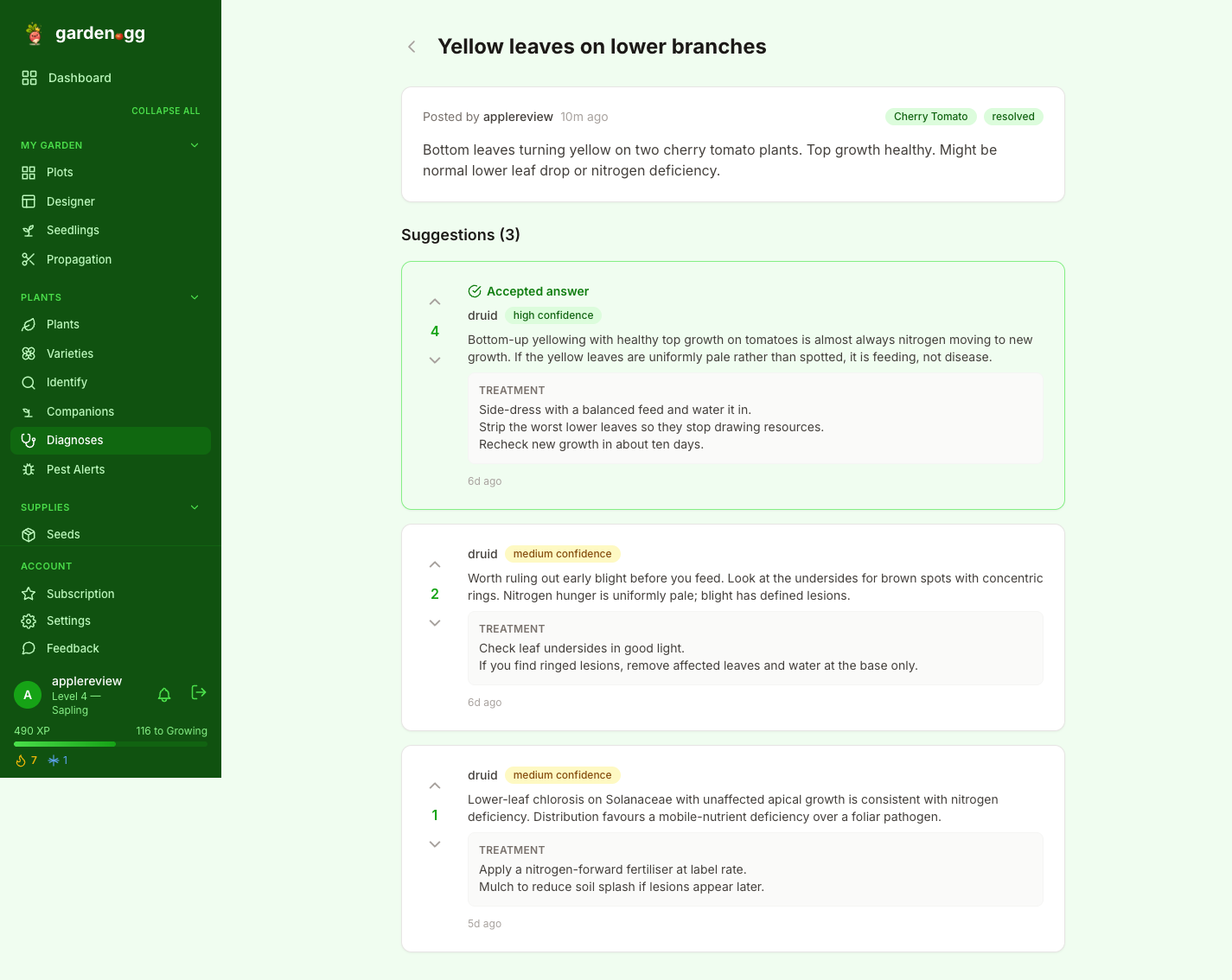
The thread above is a good example of why more than one answer is useful. The accepted reply diagnoses nitrogen movement and says to feed. The second reply, at medium confidence, says to rule out early blight first and gives the test that separates them: uniformly pale versus ringed lesions. Following the second before the first costs nothing and would have caught the more expensive mistake.
Answering is where the value compounds
A community diagnosis board dies if everyone asks and nobody answers. It is worth saying plainly: go look at the open requests occasionally.
You do not need to be an expert. Most requests are common problems, and “this looks like the septoria I had last year, here is what the underside of my leaves looked like” is a genuinely useful reply. The bar is lower than people assume.
If you are unsure, running the AI diagnosis on someone else’s photo and letting them see the structured result is a real contribution that costs you one quota and about four seconds.
Where this fits with everything else
A diagnosis is only half an answer. The other half is not getting it again next year.
Most of the structured diagnoses end with prevention advice that is really garden management: rotate the family on a three-year cycle, mulch to stop soil splash, space for airflow, water at the base. Those are all things you plan rather than react to, which is why plant diagnosis, crop rotation history, and the zone pest alert feeds end up being the same problem viewed from three distances.
The diagnosis tells you what is wrong today. The rotation history tells you why it happened. The zone feed tells you it is going around.
Community diagnoses and AI diagnosis are available on the web app, iOS, and Android.