Garden Pest Alerts by Zone: Know What's Coming Before It Arrives
By the time you find hornworm damage, the hornworm has been there about a week. You are not reacting to an arrival. You are reacting to something that already ate.
The gardeners two towns over saw it first. They just had no way to tell you.
Garden.gg now runs pest and disease alerts across 15 USDA hardiness zones, combining what gardeners report with forecast-driven warnings. Each zone gets its own feed at /pest-alerts/<zone>, and you can opt in to notifications when something is reported near you.
Pest pressure is regional and it is on a clock
Most garden pests are not random. They emerge on degree-day accumulations, arrive on weather fronts, or follow a migration that crosses the country in a fairly predictable order.
Squash vine borer adults emerge when soil warms past a threshold, which means they hit zone 8 gardens weeks before zone 5 gardens. Tomato hornworm follows a similar pattern. Late blight is different again: it travels with humid weather systems, so it can appear across a whole region in the same week regardless of who was watching for it.
The practical consequence is that your neighbours are a better early-warning system than any calendar. A zone-level feed just makes that legible.
What a zone feed actually contains
Two kinds of entries land in a zone feed.
Community reports come from gardeners in that zone who logged a pest or disease they found. These are the high-signal ones, because somebody actually looked at a plant and identified a problem. They carry the date and the affected crop.
Forecast alerts are generated from conditions rather than sightings. A stretch of warm humid nights is a fungal-disease warning whether or not anyone has reported spots yet.
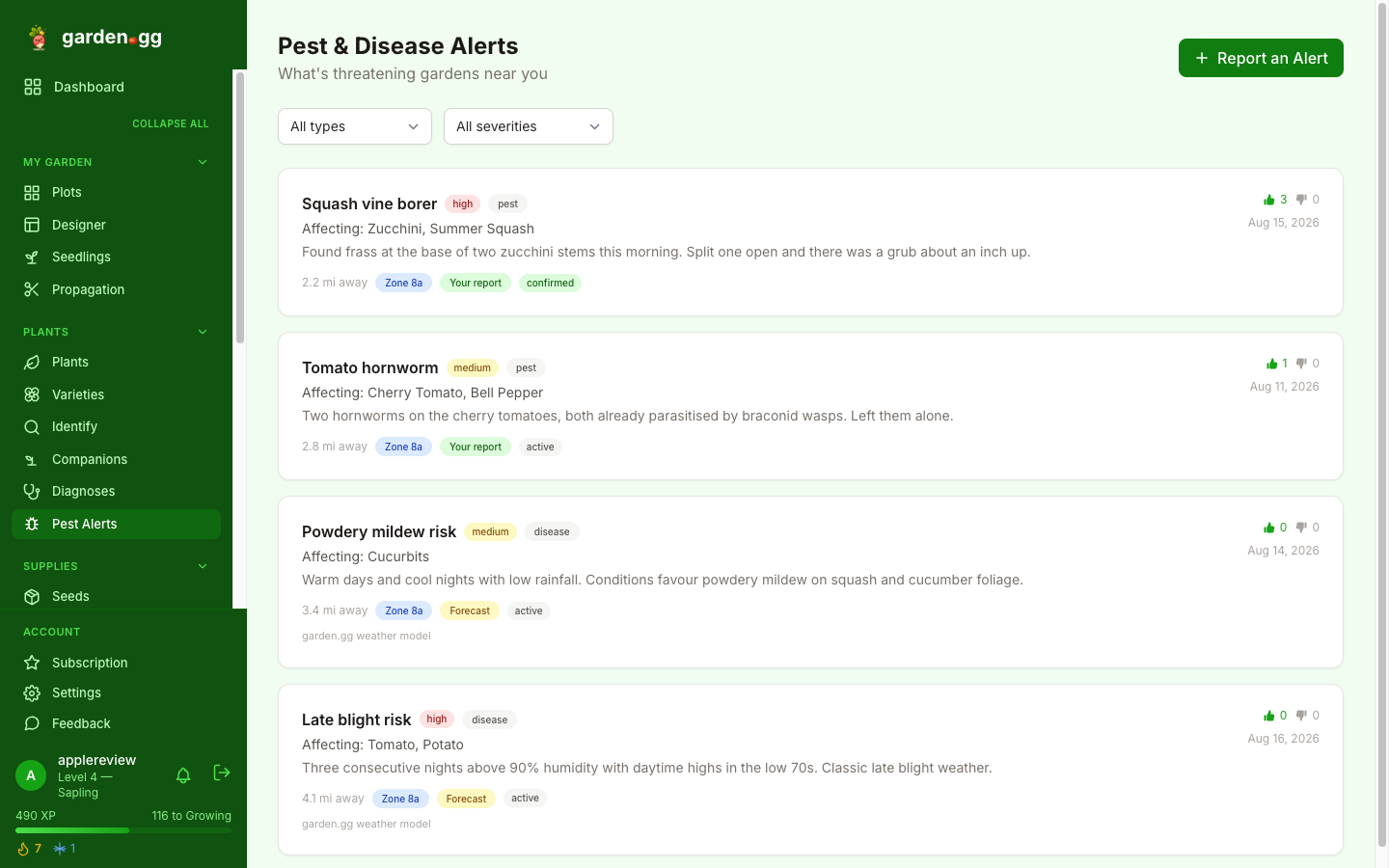
The two kinds sit side by side and are labelled. The top two carry a “Your report” badge and a confirmation count, because somebody looked at a plant. The bottom two are marked “Forecast” and attributed to the weather model, because nobody has reported anything yet and the conditions alone are the warning.
Reports are tied to a coarse location rather than a precise one. Garden.gg snaps reported positions to a tenth of a degree before storing them, which is roughly a seven-mile grid at mid-latitudes. That is close enough for “is this in my area” and far too coarse to identify anyone’s garden.
Using the zone pages
The zone pages are public and do not require an account. If you know your zone, go straight to it:
garden.gg/pest-alerts/7a
garden.gg/pest-alerts/6b
If you do not know your zone, the hub page at garden.gg/pest-alerts/ lists all 15 and links through.
What to do with the feed depends on when you read it. Early in a season it functions as a watch list: these are the problems that show up here, roughly now. Mid-season it functions as a trigger. If three people in your zone reported squash vine borer this week, go check your squash stems today rather than next weekend.
Reporting is the part that makes it work
A community feed is only as good as the reports going into it, and reporting has to be nearly free or nobody does it.
Logging a pest in Garden.gg attaches it to the plant or plot where you found it, so the report doubles as your own record. You are not filling out a form for the benefit of strangers. You are logging a problem in your own garden, and the zone feed is a side effect.
Reports can be marked resolved once you have dealt with the problem, which keeps a stale outbreak from sitting at the top of a feed for a month after it ended.
If you would rather not contribute location-tagged reports at all, the nearby-alerts behaviour is opt-out. The rest of the feature keeps working.
Some things a feed will not fix
Regional alerts tell you what is around. They do not tell you what is on your plants. A zone feed full of early blight reports is a reason to go look, not a diagnosis.
They are also weakest exactly where you might want them most: the first year a new pest reaches an area, nobody has reported it yet, because nobody recognises it. Spotted lanternfly spread for years while people photographed it and asked what it was. Community reporting catches the second year of a problem much better than the first.
And zone boundaries are a blunt instrument. USDA zones describe winter minimum temperature, which correlates with pest emergence but does not determine it. A cool coastal garden and a hot inland garden can share a zone number and run three weeks apart on hornworms.
Treat the feed as one more input. It is more useful than a generic pest calendar and less useful than walking your beds.
Where to start
Open your zone page and read the last month of entries. If your zone is quiet, that is information too. If it is busy, the top few entries are what people around you are fighting right now, and there is a good chance you have the same thing starting.
Then log the next pest you find. It takes about fifteen seconds and it is what makes the feed worth reading for the person who checks it tomorrow.
Pest and disease alerts are available on the web app, iOS, and Android. Zone feeds are public at garden.gg/pest-alerts/.