Your Garden Watering Schedule Is Wrong (Because It's a Calendar)
“Water deeply twice a week” is the most repeated piece of gardening advice there is, and it is wrong about a third of the time, because it does not know it rained on Tuesday.
Calendar watering has two failure modes and gardeners tend to have a favourite. Some people water on schedule through a wet week and drown things. Others skip the schedule during a hot dry stretch because they watered “recently” and lose a bed of lettuce.
Garden.gg’s daily task list now checks the forecast before it asks you to water.
Why “twice a week” is the wrong unit
Plants do not use water on a weekly cycle. They use it as a function of temperature, wind, humidity, sun hours, root depth, and how much organic matter is holding moisture in your soil.
A raised bed in an 85°F windy week can need water every day. The same bed in a cool overcast week can go ten days. A container needs water roughly twice as often as a bed of the same planting, because it has less thermal mass and a much smaller reservoir. Clay holds water for days. Sand does not hold it at all.
None of that is captured by a number of days, which is why the advice has to be so conservative that it is wrong in both directions.
The better rule is embarrassingly low tech: push a finger into the soil to the second knuckle. Dry at that depth means water. Damp means wait. That single test beats any schedule, and its only flaw is that you have to remember to do it.
What the rain-skip actually does
Garden.gg evaluates watering reminders once a day per plot. Before creating the reminder it pulls today’s forecast for your location and reads the predicted precipitation.
If the forecast is above 0.25 inches, the reminder is marked skipped rather than pending, and it records why. You see something like:
Rain expected. 0.4in forecast.
A quarter inch is the threshold because that is roughly the point where rain stops being a rounding error and starts meaningfully wetting the root zone. Lighter than that mostly evaporates off leaves and mulch without reaching where roots are.
Two honest caveats.
First, this is a forecast, not a measurement. It skips ahead of predicted rain rather than after confirmed rain, which means a forecast that does not deliver leaves you dry. If your local forecast is unreliable, treat a skip as a prompt to check rather than permission to ignore the bed.
Second, it reads today’s forecast only. It is not integrating a rolling soil-moisture balance across the week. It is one check, on one day, against one number.
If you have soil moisture sensors feeding the plot, you have a real measurement instead of a forecast, and that is strictly better. The rain-skip exists for the large majority of gardens that do not.
The threshold is yours to move
0.25 inches is a default, not a rule, and it is stored as a per-user preference.
Raise it if you garden in heavy clay that stays wet, or if your beds are under tree cover where a lot of the rain never lands. Lower it if you garden in containers or fast-draining sand, where a light shower genuinely does help and the plants dry out fast enough that a missed watering costs you.
Container gardeners in particular should consider turning the skip threshold up rather than down, which sounds backwards until you remember that most rain does not land in a pot. A pot under an eave gets essentially no rain at all.
One list instead of six
The other half of this is aggregation. Watering is not the only thing in a garden with a cadence, and keeping six mental lists is how things get dropped.
The daily task list pulls together what is due today across the whole app. Watering reminders per plot. Propagation prompts, which change with the batch stage, so a batch in settle asks for misting and a water-rooted batch asks for a water change. Seedling hardening steps. Harvest-readiness nudges.
In practice the list reads like this on a summer morning:
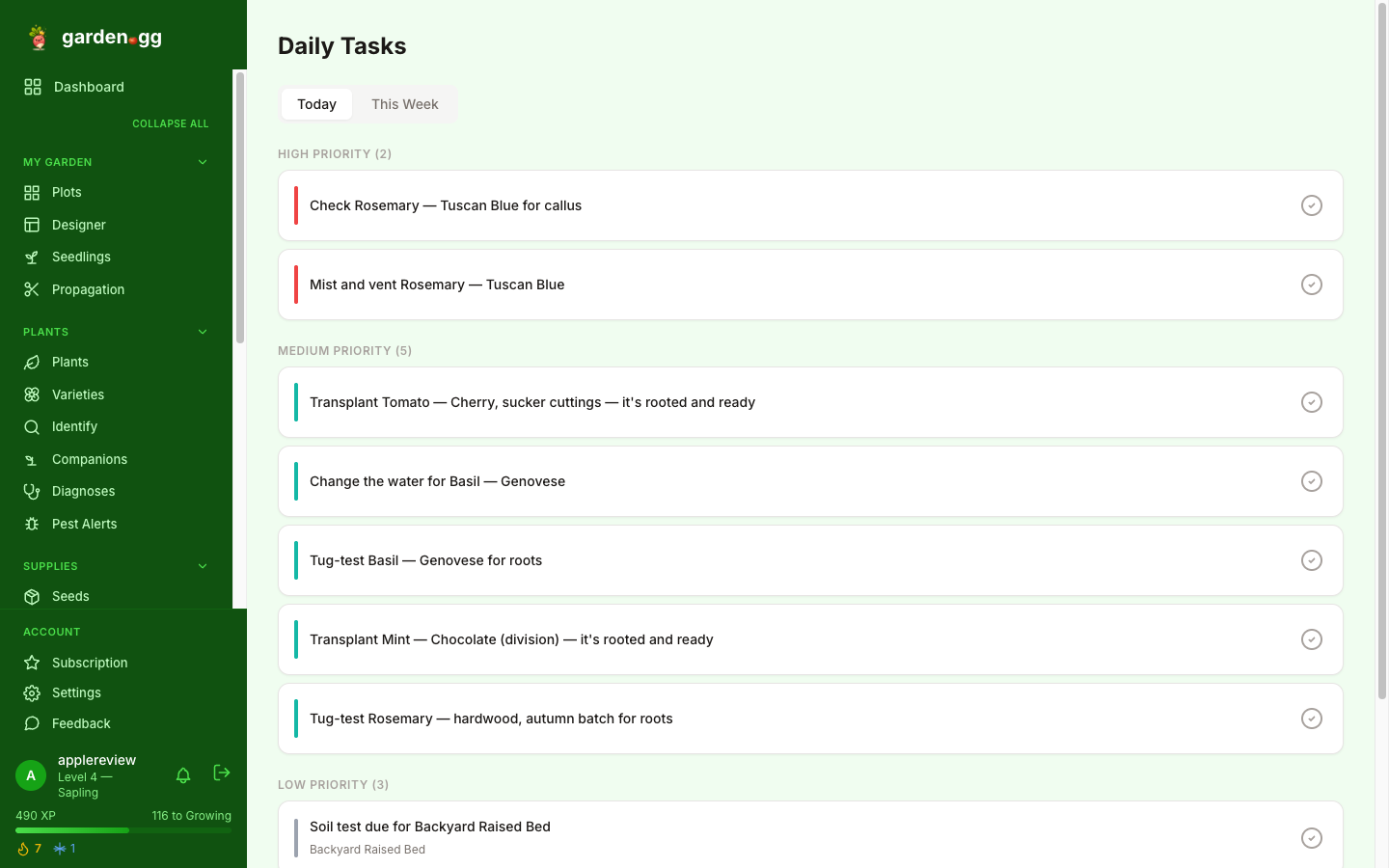
Almost everything above came from the propagation tracker without anyone setting up a reminder. The tasks exist because the batches exist, and each batch’s stage decides what it asks for. A batch in callus wants checking and venting. A water-rooted batch wants fresh water. A rooted batch wants transplanting, and says so.
There is a Today view and a This Week view. Today is for doing. This Week is for noticing that Thursday is going to be busy and moving something to Wednesday evening.
Getting reminders that you will not mute
The failure mode of every reminder system is that it asks too often, you start ignoring it, and then you ignore the one that mattered.
Three things help. Turn reminders on only for the plots that genuinely need them, because a perennial bed does not need daily prompting and a seedling tray does. Set the rain threshold to match your soil rather than leaving the default if the default is clearly wrong for you. And clear tasks as you do them, because a list with nine overdue items is a list you have already stopped reading.
That last one is the whole ballgame. A task list you keep honest is useful for years. A task list you let rot becomes noise in about two weeks.
Where to start
Turn on reminders for one plot. The one you most often forget. Leave it a week and see whether the skips line up with the weather you actually got.
If the forecast in your area is good, you will stop thinking about watering that bed. If it is bad, you will find out quickly and can move the threshold or fall back to the knuckle test, which has never once been wrong.
Daily tasks and watering reminders are available on the web app, iOS, and Android.