
Keeping a Garden Journal That You'll Actually Read Later
Most garden journals are written for about six weeks. March is dense, April is thorough, May thins out, and by July there is nothing. This is not a discipline problem. It is that writing costs effort now and pays off in eleven months, which is the worst trade a brain will ever be offered.
The version that survives is the one where the recording is nearly free and the payoff shows up sooner.
Garden.gg now has narrative journal entries attached to plots, alongside a rebuilt photo pipeline and per-plot timelapse. The three together solve different halves of the same problem.
Photos are the journal entry you will actually make
You will photograph a bed. You will not write about it. So the photo has to carry information on its own.
The photo system was rebuilt around this. Batch upload means you can dump forty photos off a phone in one go rather than doing it one at a time and giving up on photo six. Each photo gets a metadata strip showing what is known about it. Most importantly, capture dates come from EXIF rather than from when you uploaded.
That last one sounds like a technicality and is the difference between a useful archive and a pile.
If photos sort by upload time, the batch you uploaded in October, taken across May through September, all lands on one October day. The sequence is destroyed. Sorting by EXIF capture date puts every photo where it belongs on the timeline regardless of when you got around to uploading it, which means the archive tolerates exactly the behaviour real people exhibit.
Timelapse makes the payoff arrive early
The reason journals get abandoned is delayed payoff. Timelapse fixes that by giving you something back in the same season.
Point at a bed. Take a photo from roughly the same spot every week or two. Garden.gg assembles the photos for that plot into a movie, ordered by capture date.
The result is genuinely informative and not just pleasant to watch. Growth rate becomes visible in a way that week-to-week observation hides completely, because you cannot perceive a change that slow while standing in front of it. You see the exact week the squash took over. You see that the bed was shaded until mid-June, which explains why the early lettuce sulked. You see that the thing you remembered as a bad tomato year was actually a bad six weeks followed by a fine August.
Standing in the same spot matters more than photo quality. A phone camera at the same corner of the bed every Sunday beats a good camera from wherever you happened to stand.
What to write down when you do write
Photos handle appearance. Writing handles decisions and causes, which no photo records.
Worth writing:
- What you changed and why. “Moved the drip line closer to the row because the outside plants were wilting first.” In April you will want the reasoning, not just the fact.
- Dates that anchor a season. First sowing, last frost, first ripe fruit, first sign of disease. These are the numbers you compare year over year.
- Varieties, with your actual opinion. Not “grew Sungold.” Rather: “Sungold split badly after the wet week, Sakura didn’t.” That sentence is worth more than every generic variety review on the internet, because it happened in your soil.
- What failed and your best guess why. Failures teach more than successes and are forgotten faster, because nobody enjoys writing them down.
Not worth writing: daily weather that a weather service already recorded, and anything you are logging out of completeness rather than because you will want it.
Entries belong to a plot, and sharing is per entry
Journal entries attach to a specific plot rather than floating in a general diary. That constraint is doing real work. It means an entry lands next to the plants, photos, and events for that bed, so a year later the context is already assembled and you are not correlating a diary date against a planting record.
Sharing is decided per entry, not per account. An entry is private by default and you can publish individual ones. This matters because a journal contains both “the peppers are finally setting fruit” and things you would rather not broadcast. An all-or-nothing toggle makes people either overshare or, far more commonly, share nothing.
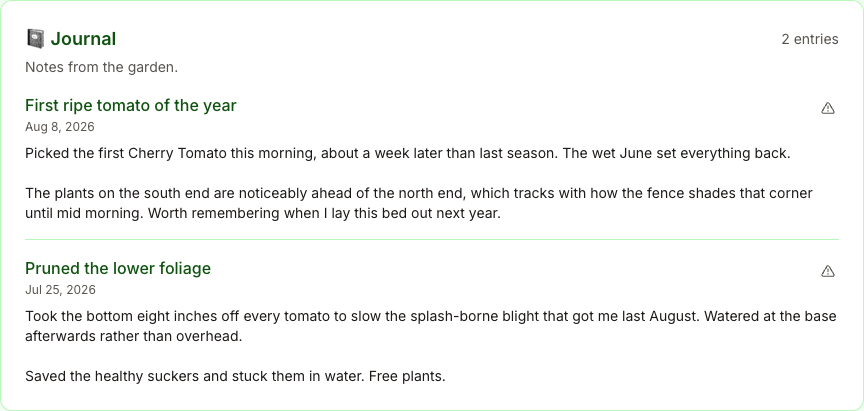
Both entries above are worth more next April than they were the day they were written. The first records that a fence shades one end of the bed until mid morning, which is a layout decision. The second records a specific reason for a specific action, which is the thing photos never capture.
Published entries appear on your public garden at garden.gg/u/<username>/journal/<entry>, which makes them linkable. That turns out to be the useful bit when someone asks how you dealt with something and you can point at the week you dealt with it.
A journal and a planner answer different questions, which is why keeping them in separate tools is such a common mistake. The planner holds the layout; the journal holds what happened in it. If they live apart, you end up correlating a diary date against a bed diagram by hand every time you want an answer. Worth checking which free garden planners keep both in one place before you commit a season of writing to one.
Why digital wins, and where paper still doesn’t lose
The honest case for digital is not that typing beats writing. It is search, photos, and the fact that the record is somewhere other than a shed.
You can find every mention of blossom end rot across four seasons in a second. Photos live with the text instead of in a phone roll. Nothing gets rained on. And the data can be exported, which matters if you ever want to leave.
Paper still wins on one thing, which is that it is frictionless in the moment. No unlock, no app, no wet fingers on a screen. Plenty of good gardeners keep a pencil and a notebook in the shed for scratch notes and move the ones that matter into a permanent record later. That is a completely reasonable system and better than a digital journal you do not fill in.
A journaling routine that survives August
Take a photo of each active bed once a week from the same spot. That is the whole baseline, and it takes two minutes.
Write only when something happens. A change you made, a failure, a first, a variety opinion. Skip the days when nothing happened, because a journal with entries only on interesting days is far more readable later than one with sixty entries reading “watered, all fine.”
At the end of the season, watch the timelapse for each bed and write one paragraph per plot while the footage is in front of you. This is the highest-value writing you will do all year and it takes twenty minutes, because the movie reminds you of everything you would otherwise have forgotten by February.
That routine holds up in July, which is the only test that matters. Related reading: how to track your garden harvest, which covers the numbers side of the same habit.
Plot journal, batch photo upload, and timelapse are available on the web app, iOS, and Android.